
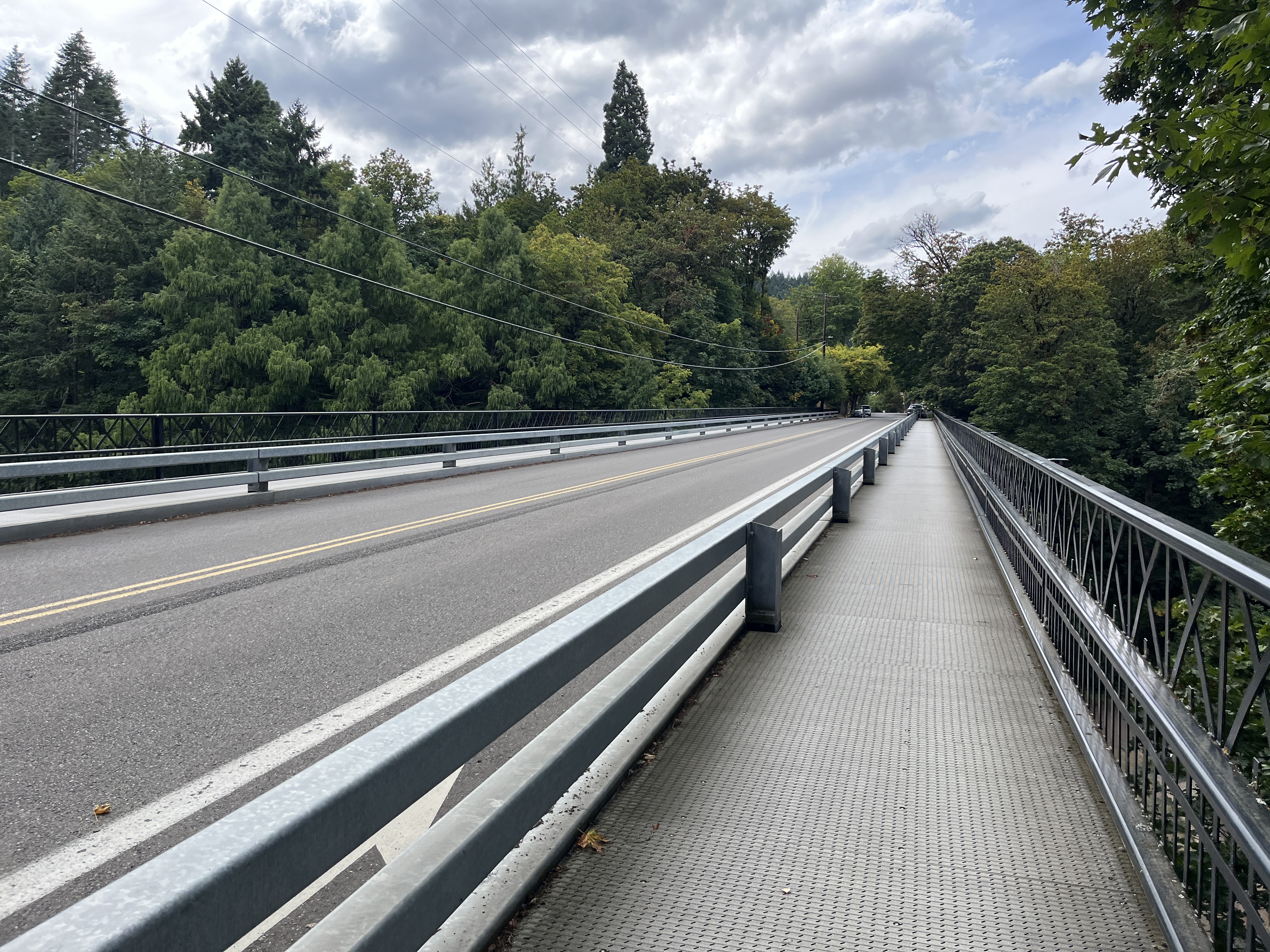
NW Thurman Street Bridge, August 2025. Another Believer, CC BY-SA 4.0. Display crop.
Willamette Heights, Portland: Homes at the Edge of Forest Park
Forest Park is where NW Thurman Street ends. Drive up Thurman from the shops on NW 23rd Avenue, cross the bridge over Balch Creek, and you’re in the heart of Willamette Heights. At the far end of the neighborhood, cars stop at the Leif Erikson gate and the route continues into the trees on foot or by bike. That’s the appeal of this hillside: the forest is right there, and the shops and restaurants of Northwest Portland are still close.
I’m Nathan Stancil, a broker with Real Broker LLC. I like Thurman both as a drive and as a walk. The streets up here feel tucked away, and so does the pocket just southeast of the hill.
One bridge, two levels of Northwest Portland
From the sidewalk on the Thurman Street Bridge you’re already well above the entrance to Lower Macleay Park. From the path below, you can look back up at the steel trusses holding the street above the ravine. The street and trail are close on a map but serve different trips. NW Thurman is the way drivers come up from the NW 23rd shopping district. The Lower Macleay entrance is down on NW Upshur; it isn’t a second road up onto the hill.
The houses that introduced buyers to the hill
Willamette Heights was platted in 1890. The developers built the Henry M. Grant House in 1892 to help sell the new development. At 3114 NW Thurman, the rock retaining wall lifts a wraparound porch above the sidewalk. Across the street, the Melinda E. Morgan House went up in 1893–94. Its projecting bay gives it some of the asymmetry of the Queen Anne house opposite, but its broad front and porch columns look toward the Colonial Revival. Both are private homes; their National Register records let you compare the buildings without leaving the sidewalk.
A decade later the Lewis and Clark Exposition brought visitors to the fairgrounds below the hill. The developers saw an audience for a new kind of house. Oregon’s historic-preservation records describe six speculative designs by Emil Schacht in Willamette Heights, the earliest dating to 1904, when his Craftsman designs were still a departure in Portland. The Thurman Street Bridge was the neighborhood’s gateway at the time of the exposition. Its deck and sidewalks have been rebuilt; the historic trusses beneath are still doing their original job.
Two different ways into Forest Park
At Lower Macleay, the paved section follows the canyon to a viewing area beside Balch Creek. The trail continues beyond it toward Wildwood. Walking and mobility devices are permitted; bicycles are not. The Leif Erikson gate at the top of NW Thurman opens onto a broad gravel road used by walkers, runners and cyclists. If being able to ride straight into Forest Park is part of the appeal, it’s the upper gate you want to locate, not the path under the bridge.
The last stretch of Thurman also affects the homes beside it. Portland Parks measures about 1,400 feet from NW Gordon to the gate, with a maximum grade above 10 percent. It counts space for roughly nine cars near the gate and describes parking spilling onto residential streets when the trail is busy. A home with off-street parking at the upper end of Thurman offers something different from the same house a few streets from that approach.
Willamette Heights in Northwest Portland
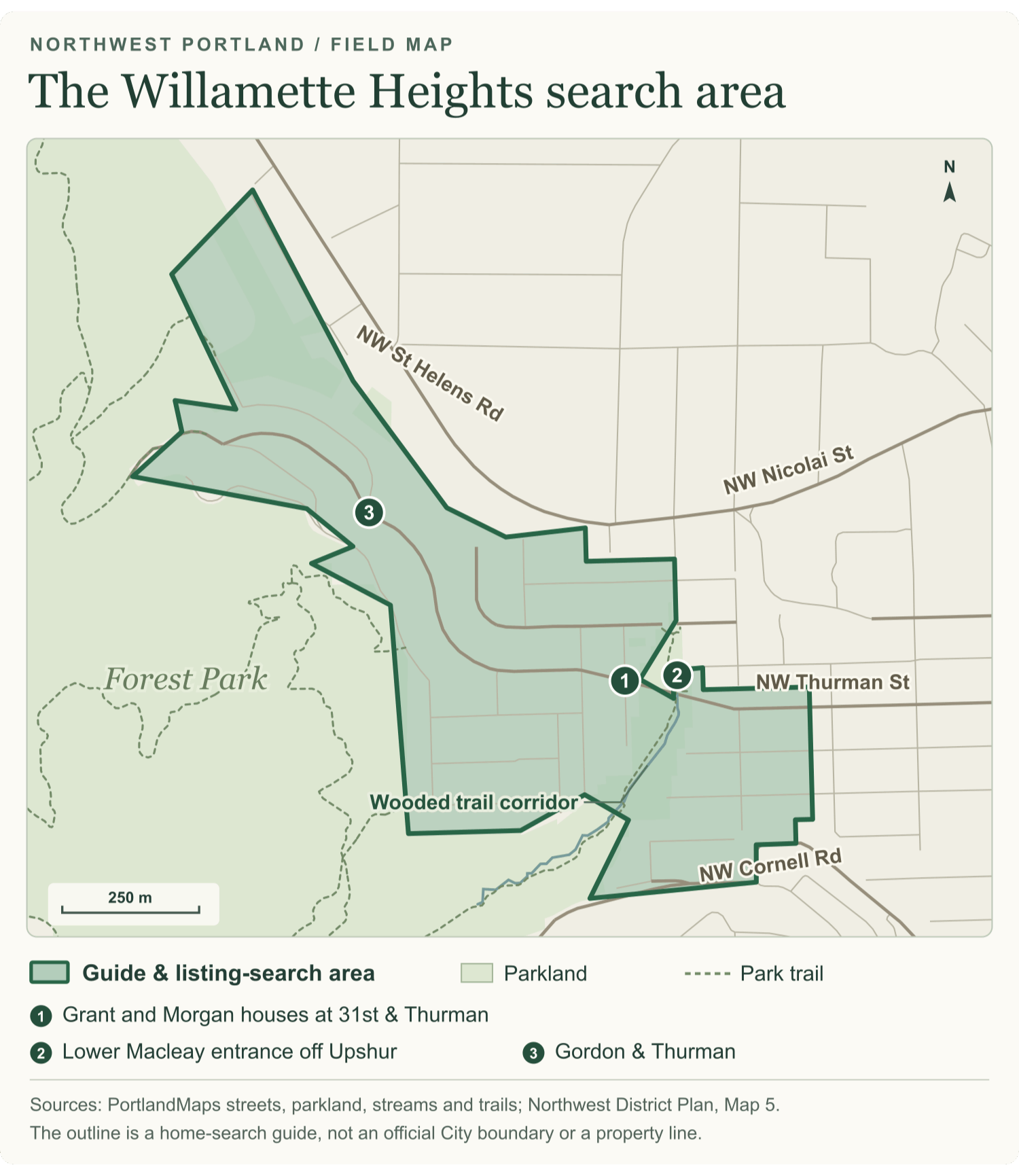
Willamette Heights is part of Portland’s Northwest District, not another name for the whole district. Map 5 in the City’s adopted Northwest District Plan labels the hillside on both sides of the wooded ravine. For this guide, I use one search area: the homes above the Thurman bridge, the wooded trail corridor, and the residential streets toward NW Cornell Road. Northwest Heights, farther west, is a different Portland neighborhood.
From the shops to the park
Thurman also gives you an easy way to picture the connection back to town. St. Honoré Boulangerie is at 2335 NW Thurman, just off NW 23rd. The bakery and the houses near the forest are on the same street, but the return from the storefronts to a hillside address is the uphill half of the trip. For someone comparing the heights with a house on the flatter blocks around Wallace Park, that matters more than a neighborhood-wide walkability score.
Walk from NW 23rd and Thurman to Lower Macleay Park on UpshurA porch, a terrace and a level yard are different things
At the Grant House, lifting the porch above the street gave the front rooms some separation from the sidewalk. On a lot that drops away from the street, the opposite arrangement is possible: an entrance close to street level with the backyard a floor below. Both houses might promise outdoor space. One may let you carry dinner straight out from the kitchen; the other may give you a deck in the trees but no level patch of ground on that floor. The useful distinction is where street, main floor and usable ground actually meet.
At the Hoke House on the Forest Park edge, the steep site left relatively little ground to build on. Skylab’s design uses decks and patios on different sides of the living spaces, reached through full-height openings. It’s a different response to the hill from a raised front porch: the outdoor rooms face different directions so they can catch sun or shelter at different times. The architect’s project photographs are a good illustration of why a large lot and a large lawn are not interchangeable here.
What changed behind the shingles?
Where NW 32nd bends into Quimby, a 1903 house by Joseph Jacobberger still presents its steep gables to the street. Behind them, the uses of the rooms have changed considerably. Skylab’s project photographs and account show how the kitchen moved into the old dining room. The new cabinets were designed to look like pieces of furniture against the historic wood paneling. From the street you see a shingled period house; the way the owners cook, eat and move through it owes just as much to the renovation.
That’s a useful comparison for two listings with similar dates and square footage. A freshly finished lower level is not the same thing as more living space on the floor where you enter. Sellers can make the difference clear with a floor plan by level and a short record of which improvements were made when. Buyers can then decide whether they value the original arrangement, the reworked one or a particular connection to the yard.
Willamette Heights homes for sale
Compare the location as well as the house. The streets by the Thurman bridge and the homes up by the Leif Erikson gate have different relationships to the shopping district, the park entrances and the grade between them.
These active listings fall inside the outline above, from the Thurman hillside across the wooded ravine to the homes near Cornell.
Compare nearby Northwest Portland guides
- Northwest District: the flatter blocks around Wallace Park, the NW 21st and 23rd shopping streets, and Slabtown.
- Kings Heights / Hillside: another residential hillside above Northwest Portland, approached from the Cornell and Westover side.
5 Featured Properties Available

$1,949,000
2936 NW SAVIER ST, Portland, OR 97210
Listed by Amico Group Realty


$994,900
3464 NW SAVIER ST, Portland, OR 97210
Listed by Think Real Estate

$1,650,000
1625 NW 29TH AVE, Portland, OR 97210
Listed by Keller Williams Sunset Corridor


Questions about buying in Willamette Heights
Does the bus stop at Thurman and Gordon work for a regular commute?
Not as an all-day route. TriMet’s Line 26 provides two school trips on weekdays. Farther east, Portland Parks identifies Lines 15 and 77 at NW 27th and Vaughn for the Lower Macleay approach. Check those schedules from the address you’re considering, rather than assuming the upper Thurman stop has the same service as NW 23rd.
Does a Willamette Heights address make a home a historic landmark?
No. The outline in this guide is for finding homes. It does not establish a historic district or tell you whether an individual house is a landmark. Portland’s Historic Resource Inventory includes several categories, not just designated landmarks. If you’re considering new windows, an addition or another exterior change, identify the property’s designation first, then check the requirements for that project with the City.
Where can I check the history of a remodel?
Start with the street address in the City’s PortlandMaps permit-search guide. Look for the permit description and final status for the work you care about, such as a basement conversion. One permit doesn’t document an entire renovation, and not every older record is online. The City explains how to request more complete records.
Sources include the City of Portland, National Register documentation, Oregon State Historic Preservation Office, Skylab Architecture and TriMet. Tour-banner photo: Henry M. Grant House in 2008, Ian Poellet, CC BY-SA 4.0. Display crop and darkening.

If you’re buying, send me the listing and tell me what drew you to it. If you’re thinking of selling, we can decide which changes to the house or site a buyer will need help seeing in the photos.
Let’s discuss a home or plan a tourTalk with Nathan about Willamette Heights
Have a house in mind? Send me the street address.